 Get Quote

Dish Rack Buying Guide for Retailers: Capacity, Drainage and Packaging
Choose a dish rack around the dishes it must hold and the counter it must fit, not the number of tiers alone. For a retail range, usable capacity, drainage and cleaning should be reviewed together with the packaging and target price position.
Check capacity with a representative load
Capacity should be discussed in practical terms rather than by a single headline number. A rack designed for everyday family use needs room for dinner plates, bowls, cups and cutlery without becoming unstable. A compact model may be intended for smaller kitchens, apartments or secondary worktops. The spacing between wire sections matters as much as the overall size because it determines whether plates stand securely or slide together.
Decide where the water will go
Drainage is another key decision. Some designs use an integrated tray, while others rely on an open construction that allows water to run off. The choice depends on the intended use and the retail price point. A tray can make a product more convenient for countertop use, but it also changes the number of components, the packaging plan and the cleaning routine. Buyers should ask to see the product in a realistic loaded condition, not only empty.
Review the finish and contact points
Material and finish need to suit the kitchen environment. A wire rack may be powder coated, plated or finished in another way depending on the desired appearance and durability requirements. The finish should be evaluated with the product’s contact points in mind: where water collects, where plates rest and where consumers are likely to handle the rack. Small feet, protective sleeves and accessory holders can all improve daily use when they are designed into the product rather than added late.
Build a range with meaningful size differences
For a retail range, size differentiation is often more useful than a long list of similar designs. A well-chosen small, medium and larger option can address different households while simplifying merchandising and replenishment. Clear packaging should show the rack’s footprint, major features and any included accessories so customers know what they are buying.
Compare formats before comparing prices
| Format | What to review | A question for the sample review |
|---|---|---|
| Low-profile rack | Countertop footprint, plate support and tray access | Can plates be removed without disturbing cups or cutlery? |
| Tiered rack | Vertical clearance, balance and access to lower levels | Does a full upper level make the base unstable? |
| Rack with removable accessories | How the tray, utensil holder and feet attach | Can parts be removed for cleaning without becoming loose in use? |
What to check before approving a sample
- Measure the assembled footprint, not only the retail carton.
- Try the plate and bowl sizes expected in the target market.
- Check water collection and whether the tray can be removed easily.
- Look for exposed wire ends and rubbing where accessories meet the frame.
- Unpack and repack the complete set, including small components.
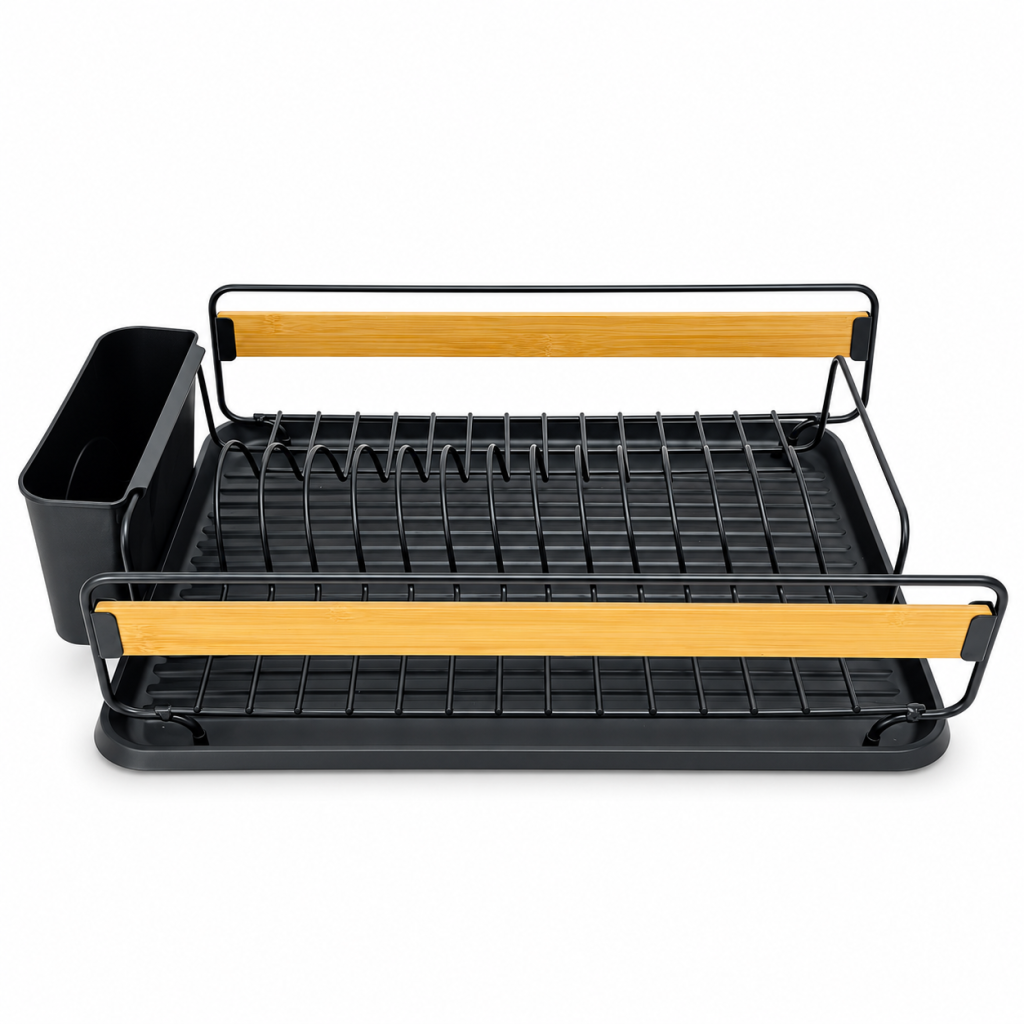
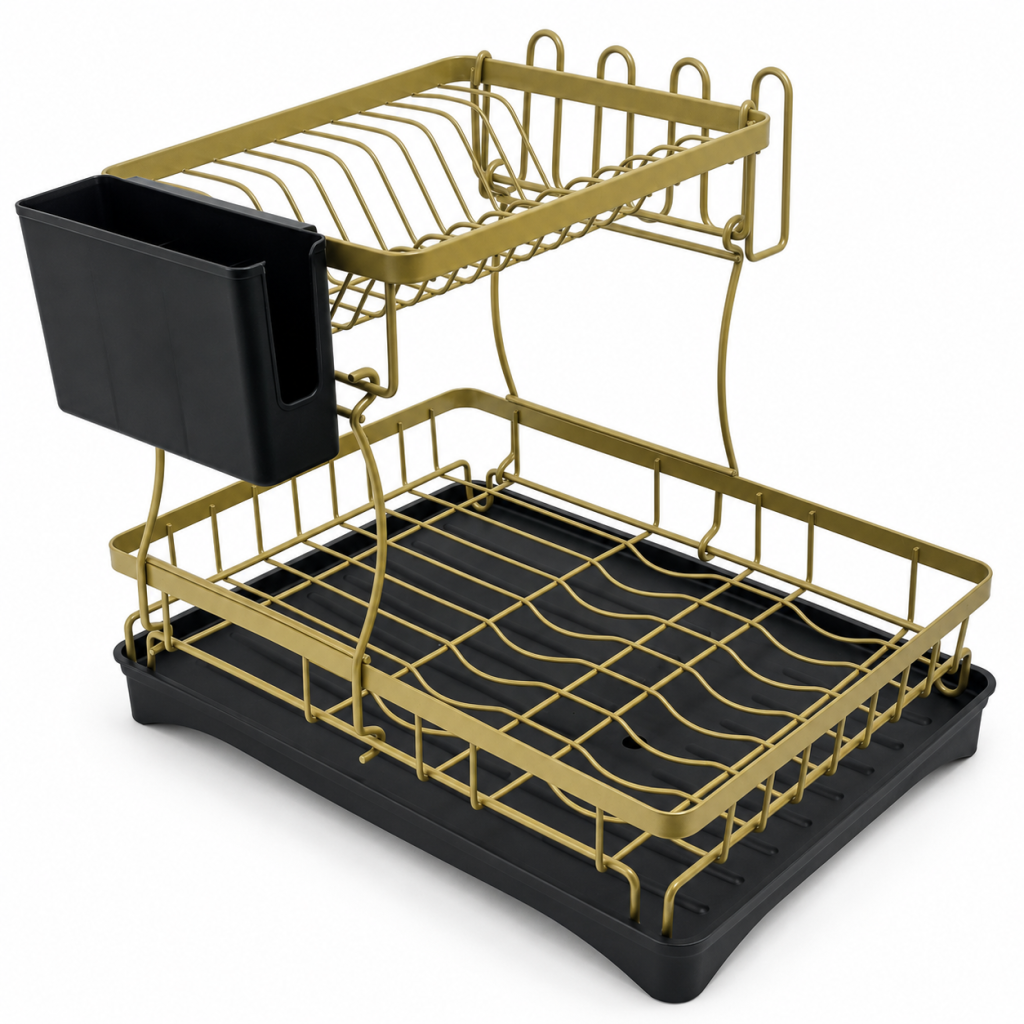
Compare our bamboo-trim dish rack and two-tier dish rack as different formats, rather than assuming that one is a direct substitute for the other. Dimensions and packing information should be confirmed for the selected item.
Discuss a dish rack range
For a private-label range, send the intended household size, available counter space and packaging format through our OEM / ODM service enquiry. See the metal organizer packaging guide for the next stage.